
New to gardening or just looking for confirmation of the key tools every gardener needs in the garden? Regardless of where you are in your gardening journey, the number and types of gardening tools available to help you in your greenthumb pursuits can be very confusing. A visit to any hardware, nursery or gardening specialist store can leave even the most seasoned gardening pro either elated at the vast range of options or perplexed at what is actually needed to ensure the basics are at hand in the garden shed ready for the most common gardening activities.
Below is our list of the 9 essential gardening tools we think every greenthumb gardener needs at the ready.
1. Garden Gloves for greenthumb gardeners
Garden Gloves are possibly the most important piece of equipment as they will keep your hands and forearms safe from bites, scratches and other nasties in the garden and provide a protective barrier so you can get on with the job at hand.

Good quality and durable garden gloves are a must. They do however come in a myriad of different versions all designed for different types of gardening activities. For an all rounder option that will protect your hands and arms we suggest making sure your garden glove choice is:
- a snug fit
- made of breathable durable fabric that wont wear out
- waterproof
- has a generous length to ensure your wrists are covered
2. Secateurs (pruning shears or hand pruners)

Depending on where you grew up you will know hand pruners as Secateurs (UK) or Hand Shears (US). You may also know these hand tools as hand pruners or pruning snips. Secateurs are one of the handiest garden tools as they are strong enough for pruning jobs on thick branches and delicate enough for rounding off soft foliage or overgrowth. Its worth investing in a good pair of secateurs as they are one of the most used tools for gardeners. Invest wisely and think about whether anvil or bypass secateurs are best for your gardening needs.
Anvil secateurs work like a knife where the blade is pushed through the plant material and are generally best for living plants or green wood.
Bypass secateurs work like scissors with 2 blades working together. Bypass work better to cut through dead or dried out branches and stems.
3. Garden Hose with adjustable nozzle
Watering is a one of the key elements for your garden plants to flourish. One of the great challenges of successful gardening is to work out the right amount of water/moisture your garden and indoor plants need to flourish.

A garden hose with enough length to reach the furtherest corners of your garden and with a nozzle that allows you to modify both the type of stream and amount of flow of the water is a must to ensure you can cater for the different needs of your outdoor garden plants.
When purchasing a garden nozzle, look for a hand gun style as these are easy to control. Where possible purchase one that has an adjustable dial to control the type of stream coming from the hose. This is particularly important (and handy) when you want to modify the amount and pattern of the water. Water pattern refers to the variations on the water streaming that a nozzle can give (ie a shower of water, a continual stream, an arc stream or a wide spray etc). An adjustable nozzle provides a variety of different streams for all types of watering needs. Most hand held nozzles are made of plastic however the quality can vary so go with a reputable brand made from durable materials. Whilst it can be tempting to leave your nozzle on the hose ready to go at all times, we recommend removing it and storing it in your garden shed or out of the weather. Long exposure the elements will reduce the useful life of your nozzle as many plastics can split, fade and lose their strength. Read Watering – How much is too much?
4. Watering Can
Whilst a garden hose will allow you to water your outdoor garden based on the individual watering needs of the plants, patio potted plants and indoor plants need a different solution.

A watering can is an essential tool in your garden shed to enable you to water plants that a hose can’t reach.
The best way to ensure you provide the right amount of moisture in the soil to your outdoor potted and indoor plants is to use a watering can. They are designed to transport smaller amounts of water to areas where using a hose isn’t practical. Watering cans allow for very targeted watering so they can also be useful if there are specific requirements to soak individual plants within your garden. They can also be more economical for smaller watering jobs than a garden hose.
Top 5 considerations when choosing a watering can:
- Capacity – Water can be heavy so consider the types of plants you will be watering, their location and your strength when deciding the capacity of your watering can. If you are planning to water hanging plants or those in hard to get to corners of the garden you may want to consider a smaller can that will be easier to life when full. Generally outdoor cans will come in larger sizes and indoor cans will be smaller.
- Type of mouth. The mouth of a watering can is the area at the end of the spout where the water pours form. Watering cans have 2 different types of mouths. Rose for a shower effect and flow for a more targeted stream of water. you might decide to have one of each depending on the watering requirements of your plants.
- Material – Obviously the material your can is made form will determine how you care for it and whether you store it.
- Spout – the spout is the tube leading from the main container that connects it with the mouth of the watering can. The tubes vary in length and its worthwhile considering whether a short or long tube is needed to get the water flowing where your plants need it.
- Handle – make sure the handle feels comfortable for you to ensure you have control of the watering can. The position of the handle (ie across the top of the can or on the side) will determine how you ultimately hold the can and individual preference will determine what is best for you. When considering the placement of the handle, think about how you will hold the can to fill its, transport it and control it whilst watering.
5. Hand Trowel, Fork and Rake

Like all garden tools their are lots of variations on hand tools. We think the 3 key ones that will cover most of your needs are a fork, trowel and rake. These are essentially hand held versions of their ‘big brothers’ that we will cover in this post.
These smaller versions are great for working in tight spaces, with small plants such as seedlings, bulbs or newer growths and for preparing smaller garden beds to be planted. They are great when the job requires a more targeted, meticulous or gentle approach than what can be achieved with their larger counterparts.
Potting plants and smaller garden beds and getting into tight spaces on your hands and knees generally require these smaller versions.
6. Garden Rake

A rake is the handiest of garden tools for gathering debris of any kind off the top of your lawn or garden. Those living in areas where pretty but voluminous brown, orange and yellow leaves adorn the streets during fall/autumn will understand the value of having a rake on hand to make the never ending chore of gathering up leaves and composting them an easy chore.
Rakes can also be handy for levelling out soil and other garden matter. A rake consists of a handle and a head that has a set of tines. The tines are the element that captures the garden matter to move it. There are a many variations on the simple rake designed for different garden jobs which can make shopping for one confusing. The most common rake varieties are the leaf rake and the garden rake.
- Garden Rake – has a nail head made out of short metal tines. Used for preparing garden beds, aerating soil and moving soil, mulch and other heavier garden matter. It is a heavier rake than the garden rake and designed for digging into soil, mulch and other weighty garden matter. Used for preparing garden beds, aerating soil and moving soil and mulch.
- Leaf Rake – has a fanned shaped head with tines generally made from light weight metal, bamboo or plastic. Is designed for scooping up leaves and and softer debris across the top of lawn or garden beds. The fan head allows a larger areas to b covered.
3 things to consider when choosing a rake:
- The type of garden jobs you need to complete. Choose the right type of rake for the job. Generally a leaf rake will not have the strength in the tines to aerate or move soil and a garden rake can damage lawn or underlying garden beds if used to scoop leaves etc
- The weight of the rake. Raking can be hard on your legs and back particularly if you are covering a large area. The weight of the rake can make a significant difference for the user. Look for fibreglass over wooden handles and for a lighter overall rake and leaf rakes with wider rather than longer span of tines.
- The durability of the material its made from. Bamboo and some plastics used for leaf rakes wont have a long life. Look for aluminium, polyresin or industrial plastic tines.
7 & 8. Spade versus a Shovel – and yes you need both!
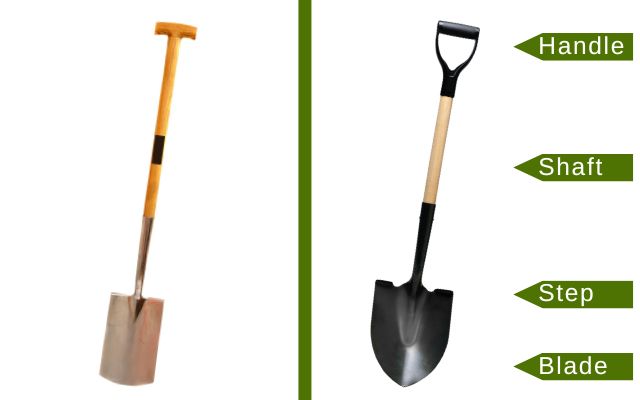
Shovel blade with D handle (right)
A common misnomer is that the term spade and shovel refer to the same thing.
Not so and lets clear that up now. Both spades and shovels are designed for moving garden material however the subtle design differences between the two make them better for specific types of jobs.
Spades and Shovels both have 4 main components:
1) a handle commonly D or T shaped handle for better control,
2) a shaft,
3) a step and,
4) a blade
The key differences in the blades are:
- Spade – A spade has a square shaped blade that is generally smaller and flatter than the shovel. This makes it a better option for digging and cutting though soil; churning soil, edging garden beds or digging holes.
- Shovel – A shovel’s blade is generally wider and has a rounded edge designed for lifting and moving garden matter. It is generally smaller than a shovel that has a more sounded head designed for moving garden material.
2 things to consider when choosing a spade and shovel:
- Shaft set – Make sure the shaft is set flush and not offset to the blade. A shaft set flush to the blade provides leverage for digging or hoisting matter out of the garden. This will be easier on your back than an offset shaft.
- Shaft length – for shovels, make sure there is enough length in the handle to help with balance when lifting. A shorter shaft is better for spades allowing for comfortable use of the step to dig deeper into the ground.
9. Wheelbarrow
Wheelbarrows are small ‘movers‘. Although handy, a wheelbarrow may not be a must have in a small garden however is an essential for those with mid to larger sized gardens. Wheelbarrows have many uses in gardening, building and construction. Gardeners will generally use a wheelbarrow for moving garden materials, plants, mulch, tools, soil, compost, sand etc. If you have a smaller garden or think you would use a wheelbarrow infrequently, a good alternative is a smaller garden cart.
3 things to consider when choosing a wheelbarrow:

- Handle. Wheelbarrows generally come with timber or metal handles. Both provide good control however timber is lighter than steel. Heavier duty wheelbarrows will likely have steel handles. Consider what makes sense for the type of use your wheelbarrow will get.
- Size of the tray – The trays come in different sizes and shapes. The size of your garden and therefore the volume of matter you are likely to move, will depend on the size tray you need.
- One wheel or two – Wheelbarrows generally come with one wheel at the front. You can buy a double wheeled barrow and these provide more stability for larger loads than a single wheel.
Visit Gardening Basics for more information on getting started in your garden!